Dock Plate vs Dock Board: What the Capacity Number Doesn't Tell You
Dock plate vs dock board: what do the key figures show?
Vestil publishes a 10,000 lb dock plate that excludes fork trucks and 10,000 lb dock boards described for fork-truck loading. The figures below distinguish manufacturer specifications, our calculations, and regulatory requirements; all were checked against primary sources on September 14, 2026. 8 10 11
- A 10,000 lb dock plate and a 10,000 lb dock board are not interchangeable. Vestil lists the EH-6024 dock plate at 10,000 lb uniform capacity with fork-truck use excluded, and lists the TS-10-6048 and BTA-10006048 dock boards at 10,000 lb uniform capacity in families described for fork-truck loading. Source: Vestil model charts and application descriptions, checked September 14, 2026. 8 10 11
- The highest-rated dock plate in this selected dataset outrates its lowest-rated dockboard by nearly 15 to 1. Vestil's EH-7224 dock plate is published at 11,900 lb uniform capacity with fork trucks excluded; all six Vestil AHTD hand-truck dockboard models are published at 800 lb uniform capacity. Source: Vestil charts; ratio computed by Harrisburg Dock Door Repair Research, September 14, 2026. 8 9
- The longest dock plate retains 33.0%–62.5% of the shortest plate's rating in each of 15 selected fixed-width groups. In the separate six-model Vestil AHTD family, published lengths run from 35-7/8 to 95-7/8 in and every model is rated at 800 lb; that observation does not establish the cause or apply to all dockboards. Source: Harrisburg Dock Door Repair Research calculations from Vestil and Bluff charts, September 14, 2026. 8 9 12
- Four dock plates cataloged at 60 x 48 in carry ratings from 2,700 to 4,800 lb: the highest is 77.8% above the lowest. The selected records are Copperloy LP60-48, Vestil E-6048, Bluff A6048 and Vestil EH-6048; their rating labels and dimensional conventions are not established as interchangeable. Source: manufacturer specifications and Harrisburg Dock Door Repair Research calculation, September 14, 2026. 8 12 15
- The 2015 product-standard definition distinguishes supporting structure. LODEM's guidance reproduces ANSI MH30.2-2015 definitions describing a dockboard's supporting side members and a dockplate without additional supporting members; this is historical edition evidence, not a quotation from the current standard. Source: MHI/LODEM guidance, checked September 14, 2026. 5
- ANSI MH30.2-2022 is the most recent edition listed by ANSI on September 14, 2026. MHI's public summary describes typical heavy-duty board and lighter-duty plate applications, but that summary does not establish whether the formal definitions changed from 2015. Sources: ANSI and MHI/LODEM, checked September 14, 2026. 6 7 18
- Bluff's selection guide uses different reference loads for boards and plates. Its chart pairs a 5,000 lb four-wheel forklift rating with a 15,000 lb board, while its plate guidance refers to the heaviest load transported; these are selection instructions, not a disclosed load-test formula. Source: Bluff guide, revision 20160708, checked September 14, 2026. 14
- Bluff's chart implies 4.00–4.29x for three-wheel forklifts and 3.00–3.33x for four-wheel forklifts at the upper endpoints of its listed brackets. Vestil's BTA/TS manual separately specifies 4x and 3x respectively; neither source supplies a universal approval for any truck and board. Sources: Harrisburg Dock Door Repair Research calculations from Bluff and Vestil's November 14, 2025 manual, checked September 14, 2026. 14 20
- At a 7 in height differential, Bluff's guide lists a 60 in plate and a 48 in board for a propane forklift: the plate is 25% longer. Its electric-forklift board column also lists 60 in; these are manufacturer-specific chart entries, not general slope limits. Source: Bluff guide, revision 20160708; calculation checked September 14, 2026. 14
- Bluff's 25 selected plate records agree with its guide at seven exact height steps and the upper endpoint of an eighth band. The page lists 1, 2, 3, 4, 5, 6, 7 and 8.5 in; the guide's final plate band is 8–8.5 in. Source: Harrisburg Dock Door Repair Research cross-check of Bluff's model chart and guide, September 14, 2026. 12 14
- A 33.3% thickness increase accompanies a median 1.71x published rating across 24 matched Vestil catalog sizes. The comparison is between 3/8 in E-series and 1/2 in EH-series aluminum plates; it does not isolate thickness in a physical experiment. Source: Harrisburg Dock Door Repair Research calculation from Vestil's chart, September 14, 2026. 8
- OSHA's dockboard fall-protection exception has three conditions, including a fall hazard no greater than 10 ft. The operation must also be solely materials handling with motorized equipment, and the affected employees must be trained under 1910.30. Source: 29 CFR 1910.28(b)(4)(ii), eCFR, checked September 14, 2026. 1
- Three cited duties concern safe handling, transport-vehicle movement and employee training. Section 1910.26(e) addresses portable-unit handling means; 1910.26(d) addresses vehicle movement while employees are on the dockboard; 1910.30(b)(2) requires placement-and-securing training. Source: eCFR federal general-industry text, checked September 14, 2026. 1 2
- Pennsylvania has no OSHA-approved State Plan as of September 14, 2026. Federal OSHA covers most private-sector workers in the state; state and local government workers are not covered by federal OSHA. Source: OSHA State Plans, Pennsylvania entry, checked September 14, 2026. 4
By Harrisburg Dock Door Repair Research
Last verified: September 14, 2026
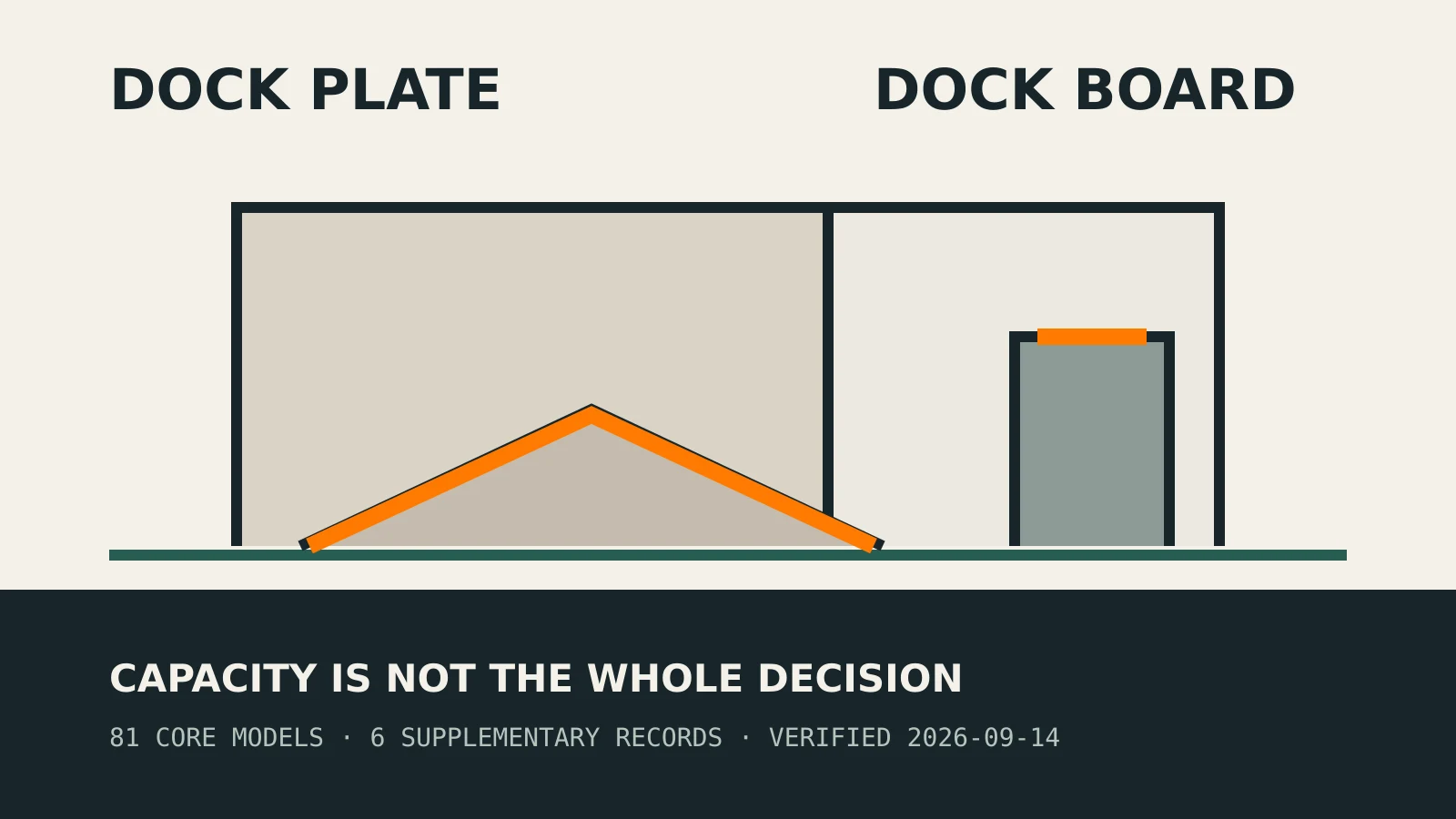
The most useful thing to know about dock plate vs dock board is that the capacity number cannot settle it. Vestil Manufacturing publishes a dock plate, model EH-6024, rated at 10,000 lb uniform capacity — and excludes fork-truck use for that family. The same company publishes dock boards rated at 10,000 lb that its literature describes for fork-truck loading. Same manufacturer, same published number, opposite answer on fork-truck use. We assembled an 81-model core census from selected current charts, plus six comparison records, to show exactly what the published evidence supports. 8 10 11
On this page: Key figures · The 10,000 lb collision · The complete capacity census · What this shows and what it doesn't · Methodology · What actually separates the two? · How do ratings change with length? · How are the ratings used? · How long does each need to be? · Does OSHA treat them differently? · Who is covered in Pennsylvania? · Why do source dates matter? · Limitations · How to cite this page · FAQ · Sources
What does the 10,000 lb collision reveal?
Vestil publishes a 10,000 lb uniform-capacity dock plate with fork-truck use excluded and two 10,000 lb uniform-capacity dock boards described for fork-truck loading. Bluff supplies a fourth 10,000 lb example, using its own capacity label, while Vestil's 800 lb hand-truck dockboard supplies the reverse naming example. The published number is identical across the first four records; the stated traffic is not. 8 9 10 11 13
Table 1. Four products published at 10,000 lb, plus an 800 lb naming counterexample
| Manufacturer | Model | Sold as | Published rating | Rating label used | What the manufacturer's literature says about fork trucks |
|---|---|---|---|---|---|
| Vestil | EH-6024 | Dock plate | 10,000 lb | Uniform Capacity (lb.) | Family excludes fork-truck use |
| Vestil | TS-10-6048 | Dock board (steel) | 10,000 lb | Uniform Capacity (lb.) | Family described for fork-truck loading |
| Vestil | BTA-10006048 | Dock board (aluminum, welded curbs) | 10,000 lb | Uniform Capacity (lb.) | Family described for fork-truck loading |
| Bluff | AC6048 | Dock board (aluminum deck, bolt-on steel curbs) | 10,000 lb | Capacity (LBS) | Family described for forklifts and pallet jacks |
| Vestil | AHTD-3696 | Dock board (aluminum, full-length curbs) | 800 lb | Uniform Capacity (lb.) | Two-wheel hand-truck application; AHTD manual excludes powered equipment |
Source: Vestil E/EH, BTA, AHTD and TS family charts; Bluff AC/BC chart; Vestil AHTD manual. Each publisher's rating label is retained. Checked September 14, 2026. 8 9 10 11 13 21
The last row is the mirror image of the first. A product Vestil calls a dock board, with welded aluminum curbs, is published at 800 lb for hand trucks. A product Vestil calls a dock plate is published at 10,000 lb and excluded from fork trucks. The name does not determine the capacity, and neither the name nor the number overrides the manufacturer's stated application. 8 9 21
What is included in the complete 81-model capacity census?
The core census contains every base model listed in the selected E, EH, A and AHTD charts on September 14, 2026: 81 models from Vestil and Bluff. Six separately selected comparison records add Copperloy and bring the downloadable dataset to 87 records from three manufacturers. “Complete” refers to those selected model-chart series, not every product sold by those manufacturers or the whole market.
Dataset files: CSV: 87 model records · JSON: the same records, source register and calculations. The methodology defines the sample and fields; the attribution reference identifies the page and dataset version.
Verification key: ★ means the published fields were checked directly against the cited primary source. It does not mean independently load-tested or certified for a particular operation. All included records carry this verification tier; blank fields mean an attribute was not established or collected, not that it equals zero.
Vestil Economizer dock plates: 50 models, two thicknesses
Vestil publishes the same 24 catalog width-and-length combinations in 3/8 in aluminum (E series) and 1/2 in aluminum (EH series), plus two additional combinations in the E series only. The whole family excludes fork-truck use. Accessories and options are not base plate models and are not counted. 8
Table 2. Vestil Economizer dock plate capacities by published size and thickness
| Published width x length (in) | E series, 3/8 in (lb) | EH series, 1/2 in (lb) | EH ÷ E |
|---|---|---|---|
| 30 x 24 | 3,000 | 5,200 | 1.73 |
| 30 x 30 | 2,300 | 4,100 | 1.78 |
| 30 x 36 | 1,800 | 3,500 | 1.94 |
| 30 x 48 | 1,400 | 2,600 | 1.86 |
| 36 x 24 | 3,600 | 6,200 | 1.72 |
| 36 x 30 | 3,000 | 5,100 | 1.70 |
| 36 x 36 | 2,500 | 4,300 | 1.72 |
| 36 x 48 | 1,900 | 3,000 | 1.58 |
| 36 x 60 | 1,400 | — | — |
| 48 x 24 | 5,200 | 8,200 | 1.58 |
| 48 x 30 | 4,100 | 6,300 | 1.54 |
| 48 x 36 | 3,500 | 5,300 | 1.51 |
| 48 x 42 | 3,000 | 4,300 | 1.43 |
| 48 x 48 | 2,600 | 3,800 | 1.46 |
| 48 x 60 | 1,800 | 2,900 | 1.61 |
| 60 x 24 | 5,700 | 10,000 | 1.75 |
| 60 x 30 | 4,600 | 7,800 | 1.70 |
| 60 x 36 | 4,100 | 6,600 | 1.61 |
| 60 x 42 | 3,500 | 5,500 | 1.57 |
| 60 x 48 | 2,900 | 4,800 | 1.66 |
| 60 x 60 | 2,000 | 3,700 | 1.85 |
| 72 x 24 | 6,500 | 11,900 | 1.83 |
| 72 x 30 | 5,400 | 9,500 | 1.76 |
| 72 x 36 | 4,300 | 7,800 | 1.81 |
| 72 x 48 | 3,400 | 5,900 | 1.74 |
| 72 x 60 | 2,500 | — | — |
Source: Vestil Manufacturing, Aluminum Economizer Dockplates (E, EH), model chart. Values are uniform capacity in pounds. EH ÷ E is our calculation, rounded to two decimals; the unrounded median across 24 shared combinations is 1.71. Checked September 14, 2026. 8
Vestil's E-series descriptions explicitly use the word “usable.” The reviewed EH descriptions publish width and length without that same explicit label. The pairing above is therefore by matching catalog numbers, not a finding that all usable or clear dimensions were measured on an identical basis.
Bluff aluminum dock plates: 25 models, with a published grade column
Bluff's chart carries a per-model column labeled “14% Grade Height Up (in).” Bluff states that its plates are manufactured and tested in compliance with ANSI MH30.2, describes capacities as size-specific, and excludes motorized traffic. Those are manufacturer statements; this compilation did not repeat the testing or certify the product. 12 23
Table 3. Bluff A-series dock plate capacities and published grade-height entries
| Model | Capacity (LBS) | Width (in) | Length (in) | 14% grade height up (in) |
|---|---|---|---|---|
| A3024 | 3,300 | 30 | 24 | 1 |
| A3030 | 2,650 | 30 | 30 | 2 |
| A3036 | 2,200 | 30 | 36 | 3 |
| A3048 | 1,650 | 30 | 48 | 5 |
| A3624 | 4,000 | 36 | 24 | 1 |
| A3630 | 3,200 | 36 | 30 | 2 |
| A3636 | 2,650 | 36 | 36 | 3 |
| A3642 | 2,250 | 36 | 42 | 4 |
| A3648 | 2,000 | 36 | 48 | 5 |
| A3654 | 1,750 | 36 | 54 | 6 |
| A3660 | 1,600 | 36 | 60 | 7 |
| A4824 | 5,300 | 48 | 24 | 1 |
| A4830 | 4,250 | 48 | 30 | 2 |
| A4836 | 3,550 | 48 | 36 | 3 |
| A4842 | 3,000 | 48 | 42 | 4 |
| A4848 | 2,650 | 48 | 48 | 5 |
| A4860 | 2,100 | 48 | 60 | 7 |
| A4872 | 1,750 | 48 | 72 | 8.5 |
| A6024 | 6,650 | 60 | 24 | 1 |
| A6030 | 5,300 | 60 | 30 | 2 |
| A6036 | 4,400 | 60 | 36 | 3 |
| A6048 | 3,300 | 60 | 48 | 5 |
| A7230 | 6,400 | 72 | 30 | 2 |
| A7236 | 5,300 | 72 | 36 | 3 |
| A7248 | 4,000 | 72 | 48 | 5 |
Source: Bluff Manufacturing, Aluminum Dock Plates (Model A-B), 25 A-series rows. The manufacturer's capacity and grade-height labels are retained; no grade was recalculated for this table. Checked September 14, 2026. 12
Four plates, same catalog size, four ratings
Table 4. Dock plates cataloged at 60 x 48 in
| Manufacturer | Model | Material | Published rating | Rating label |
|---|---|---|---|---|
| Copperloy | LP60-48 | Aluminum, 3/8 in | 2,700 lb | Capacity |
| Vestil | E-6048 | Aluminum, 3/8 in | 2,900 lb | Uniform Capacity (lb.) |
| Bluff | A6048 | Aluminum | 3,300 lb | Capacity (LBS) |
| Vestil | EH-6048 | Aluminum, 1/2 in | 4,800 lb | Uniform Capacity (lb.) |
Source: Copperloy Dockplate Specifications, PDF page 2; Vestil E/EH model chart; Bluff A-series chart. The highest of these four ratings is 77.8% above the lowest: (4,800 − 2,700) ÷ 2,700 × 100. Checked September 14, 2026. 8 12 15
That percentage describes these four published records. It is not an industry range, an equal-performance test, or a finding that the same measurement convention was used for each catalog size. Both material thickness and the manufacturer's application documentation remain part of the record.
The six supplementary comparison records
These records are included in the download but not in the 81-model core count. Listing them separately keeps the denominator visible and makes the 87-record file count reproducible.
Table 4a. Supplementary records outside the core census
| Manufacturer | Model | Catalog W x L (in) | Published capacity (lb) | Published category and stated application |
|---|---|---|---|---|
| Vestil | TS-10-6048 | 60 x 48 | 10,000 uniform | Steel dockboard; fork-truck family |
| Vestil | BTA-10006048 | 60 x 48 | 10,000 uniform | Aluminum dockboard; fork-truck family |
| Bluff | AC6048 | 60 x 48 | 10,000 | Aluminum-deck, steel-curb dockboard; forklift/pallet-jack family |
| Bluff | BC6048 | 60 x 48 | 15,000 | Aluminum-deck, steel-curb dockboard; forklift/pallet-jack family |
| Copperloy | LP60-36 | 60 x 36 | 3,800 | Aluminum dock plate; aluminum-plate description excludes forklifts |
| Copperloy | LP60-48 | 60 x 48 | 2,700 | Aluminum dock plate; aluminum-plate description excludes forklifts |
Source: Vestil BTA and TS charts; Bluff AC/BC chart; Copperloy Dockplate Specifications page 2 and aluminum-plate application description. These are attributed model specifications, not application approvals. Checked September 14, 2026. 10 11 13 15 16
What does this show, and what doesn't it show?
This census shows how two manufacturers describe and rate the selected 81 core models, with six supplementary records extending the comparison to a third manufacturer. It shows how published ratings change with catalog size within those series. It does not identify the engineering cause of the changes or establish suitability for a particular dock.
It is not a load test — we tested nothing and measured nothing physically. It is not a representative market survey. The dimensional bases differ between publishers, so a 60 in width from one catalog is not guaranteed to represent the same usable width as a 60 in width from another. Manufacturer capacity definitions and selection instructions were read where available, but a common model-by-model test protocol was not established across the dataset. 8 9 12 15 20 21
Most importantly: every capacity figure here sits alongside a manufacturer's application statement. A high number next to a fork-truck exclusion is still a fork-truck exclusion. Where a product page and a manual conflict, that conflict needs manufacturer resolution; this comparison does not choose whichever statement permits the intended operation. 8 12 16 21
How was the dataset assembled and checked?
The dataset joins published model specifications to the manufacturer's stated application and records the source and check date for each row. Calculations are descriptive summaries of those records, not measurements, engineering formulas or equipment-selection recommendations. The core sample and the supplementary records are separately identified in both downloads.
What we collected. The core contains 26 Vestil E models, 24 Vestil EH models, six Vestil AHTD models and 25 Bluff A models: 81 in total. Six supplementary rows cover one Vestil BTA board, one Vestil TS board, two Bluff AC/BC boards and two Copperloy LP aluminum plates. E and EH share a family page, while Bluff labels its page Model A-B even though the 25 transcribed rows are A-series models. We count model records, not pages, accessories or alternative names for the same row. 8 9 10 11 12 13 15
From where. Model charts, specification PDFs and manuals published by the manufacturer; regulator-hosted text for legal requirements; MHI and ANSI for standards history. A model absent from the selected current chart was not silently added from a different document. Vestil E-4224, for example, appears in the E-series bill of materials in its manual but not in the selected current E/EH chart. It remains outside this chart-defined census; that exclusion is not a claim that the model does not exist. Bluff A6042 was also absent from the selected current chart. 8 12 19
On what dates. Manufacturer source pages, manuals and regulatory text were checked on September 14, 2026. The eCFR displayed Title 29 as up to date September 10, 2026, with its last Title 29 amendment dated September 9, 2026; the amendment date is not the verification date of each section. Bluff's guide carries revision 20160708. The Vestil E/EH and AHTD/TAS manuals reviewed carry November 11, 2025 revisions, and the BTA/TS manual carries November 14, 2025. Hosting-folder dates are not substituted for document revisions. 1 14 19 20 21
How it was processed. Each source's model name, capacity, width, length, rating label and stated application was recorded in structured CSV form and checked against the primary chart. Fractions were converted exactly to decimal inches for calculation, while the visible AHTD table retains the catalog fractions. Capacity labels were preserved rather than standardized. The Copperloy table and Bluff selection charts were also checked visually to retain column alignment and range boundaries.
How counts and calculations are reproduced. One row is one model. The sample_role field separates 81 core observations from six supplementary observations; no supplementary board is included in the plate-length or paired-thickness calculations. The downloadable JSON includes the separate Bluff guide tables, the source register and the computed results. The accompanying reproduction script reads the CSVs and recomputes the results without fetching or changing live sources.
The calculations use these definitions:
- Paired thickness comparison: EH capacity divided by E capacity at each of 24 matching published width-and-length combinations; the median is calculated before rounding the individual ratios. The thickness percentage is
(0.5 − 0.375) ÷ 0.375 × 100. - Length comparison: within each of 15 manufacturer-series-and-width groups, longest-model capacity divided by shortest-model capacity, multiplied by 100. Length multiple is longest published length divided by shortest published length. Other construction details were not held constant in an experiment.
- Size index: published capacity multiplied by published length and divided by published width, with inches used for both dimensions. Its unit is pounds, but it is a descriptive index, not a permissible load. Population coefficient of variation is population standard deviation divided by mean, multiplied by 100.
- Named comparisons: the same-size percentage uses the lowest of the four selected ratings as its denominator; the 11,900-to-800 ratio and the longest-to-shortest AHTD length ratio use those explicitly named records, not market extremes.
- Guide comparisons: board capacity divided by the upper endpoint of each listed forklift-capacity bracket; the length percentage at 7 in uses the 48 in propane-board entry as its denominator. Height divided by catalog length is labeled
H/L, not ramp grade.
On the size index. It is a descriptive check, not an engineering formula and not a way to derive a rating for a model nobody published. Across Bluff's 25 A-series plates, the population coefficient of variation of capacity × length ÷ width is 0.6%. Across Vestil's 26 E-series plates it is 7.3%, and across the 24 EH-series plates it is 4.2%. Those are coefficients of variation, not maximum deviations or total ranges. The calculations show differing numerical patterns; they do not disclose any manufacturer's internal design, testing or pricing rule.
Cross-checks performed. Bluff's 25 per-model grade-height entries match its guide at 1, 2, 3, 4, 5, 6 and 7 in. The remaining 8.5 in value matches the upper endpoint of the guide's 8–8.5 in band. For forklift multiples, Bluff's bracket endpoints were compared with the independent 4x/3x guidance in Vestil's BTA/TS manual. They are related selection approaches, not identical charts or proof that every model is interchangeable. 12 14 20
Missing fields and source conflicts. A blank CSV field, or null in JSON, means an attribute was not established or was not collected for that record. In particular, Bluff A-series thickness was not established in the directly reviewed chart or product PDF and is left blank; it is not borrowed from a reseller. AHTD bend-angle statements conflict between its family page and shared manual, so no bend angle is offered as verified geometry. Neither gap changes the checked capacities, dimensions or explicit powered-equipment exclusions.
Data dictionary. record_id is the stable row identifier. Manufacturer, model, category, deck material and curb description retain the source's product identity; dimensions and thickness use inches, and capacity uses pounds. size_basis records whether a dimension is explicitly usable, overall or simply published catalog size. grade_height_up_in retains the Bluff plate-chart entry and is not a calculated slope. Application status distinguishes an explicit exclusion from a described forklift application; it is never a certification field. Source URLs, source locations, document-vintage notes, verification dates and conflict notes preserve the evidence trail.
Verification tier and version. ★ denotes direct primary-source checking of the published fields, not physical testing or independent product approval. Every included row has that tier; unresolved numeric fields remain blank rather than being promoted to verified values. Dataset version 2026-09-14 records this pass. A later model change requires a new version and re-running the calculations, not simply changing the date above the old tables.
What actually separates a dock plate from a dock board?
The historical product-standard definition draws a structural line: supporting side members on a dockboard, no additional supporting members on a dockplate. OSHA's general-industry definition uses “dockboard” more broadly, expressly including dock plates and dock levelers. Neither definition turns a capacity number into permission to use a forklift. 3 5
Table 5. What each authority or manufacturer says the two words mean
| Source | What it calls a dockboard | What it calls a dockplate | Basis and limit of the comparison |
|---|---|---|---|
| 29 CFR 1910.21(b), federal general industry | Portable or fixed gap-bridging or elevation-compensating device between a loading platform and transport vehicle; includes bridge plates, dock plates and dock levelers | Included in the broader dockboard definition, not separately defined here | Regulatory scope, not a product-selection test |
| ANSI MH30.2-2015, as reproduced in LODEM's guidance | Plate-like structure with welded or bolted supporting members along opposing sides, parallel to its span; the members also guard against runoff | Plate-like structure carrying loads without additional supporting members, typically for lighter foot or hand-truck traffic | Historical structural and intended-use description; not the current edition's text |
| ANSI MH30.2-2022, as publicly summarized by MHI/LODEM | Typically intended for heavy-duty material-handling loads | Typically used for lighter-duty hand loading or hand-truck applications | Public summary of typical duty; not evidence of a change to the definitions clause |
| Bluff Manufacturing literature | AC/BC, ATD, SC, T, SB and C applications are distinguished by traffic, duty and below-dock capability | A-B plates for non-powered equipment, including manually moved hand trucks, dollies and pallet jacks | Product-specific intended application, not a universal category rating |
| Vestil Manufacturing literature | Includes the six curbed AHTD models rated at 800 lb for hand trucks, as well as forklift-board families | E/EH aluminum plate family, with 11-degree bend and bolt-on legs; fork trucks excluded | The manufacturer's model and application statement, not the name alone |
| Copperloy literature | Describes curbed boards for forklift/fork-truck applications | Describes aluminum plates for handcarts and light material handling, excluding forklifts | Product description; conflicting steel-plate prose is separately disclosed |
Source: eCFR 1910.21; MHI/LODEM historical guidance and current public standards summary; Bluff selection guide; Vestil and Copperloy product literature. The current standard's full definitions clause was not reviewed. Checked September 14, 2026. 3 5 6 8 9 14 16 17 18
The curbs can be structure, not trim
The 2015 ANSI definition is worth reading closely because it gives the side members a dual purpose: additional load-carrying support and runoff protection. In the structure described by that definition, the members are not merely a lip added for safety. That is an attributed description of the historical standard, not proof that every raised edge on every product carries structural load. 5
Bluff says the same thing in plainer words in its aluminum dockboard copy: structural steel curbs bolt to the aluminum deck and contribute load-carrying ability. That is a manufacturer confirming the supporting role of the curbs on its own AC/BC product, not a basis for calculating an unknown board's rating. 13
What can be verified about the 2015 and 2022 editions?
ANSI MH30.2-2015 was superseded by ANSI MH30.2-2022, which ANSI lists as its most recent edition. This matters when citing the structural definition because LODEM's publicly available OSHA guidance reproduces the 2015 text. MHI's current public summary characterizes typical board and plate duty, but a summary is not the standard's definitions clause. 5 6 7 18
We did not access the full 2022 standard. We therefore attribute the historical structural description to the 2015 edition and do not claim that the 2022 edition removed or replaced it. The verified finding is the change of edition, not a verified change of definition. A reference to an ANSI definition needs both the edition and the source actually reviewed.
How does a dock plate's published capacity change as it gets longer?
Across all 15 fixed-width groups in the selected E, EH and A series, the longest offered plate retains 33.0%–62.5% of the shortest model's published capacity. The separate six-model AHTD family carries a constant 800 lb rating over its listed lengths. Those are catalog patterns, not physical experiments identifying why the ratings differ.
Table 6. Published ratings at the shortest and longest catalog lengths within each selected fixed-width group
| Family | Width (in) | Shortest model | Longest model | Length multiple | Capacity remaining |
|---|---|---|---|---|---|
| Vestil E (3/8 in plate) | 30 | E-3024, 3,000 lb | E-3048, 1,400 lb | 2.0x | 46.7% |
| Vestil E | 36 | E-3624, 3,600 lb | E-3660, 1,400 lb | 2.5x | 38.9% |
| Vestil E | 48 | E-4824, 5,200 lb | E-4860, 1,800 lb | 2.5x | 34.6% |
| Vestil E | 60 | E-6024, 5,700 lb | E-6060, 2,000 lb | 2.5x | 35.1% |
| Vestil E | 72 | E-7224, 6,500 lb | E-7260, 2,500 lb | 2.5x | 38.5% |
| Vestil EH (1/2 in plate) | 30 | EH-3024, 5,200 lb | EH-3048, 2,600 lb | 2.0x | 50.0% |
| Vestil EH | 36 | EH-3624, 6,200 lb | EH-3648, 3,000 lb | 2.0x | 48.4% |
| Vestil EH | 48 | EH-4824, 8,200 lb | EH-4860, 2,900 lb | 2.5x | 35.4% |
| Vestil EH | 60 | EH-6024, 10,000 lb | EH-6060, 3,700 lb | 2.5x | 37.0% |
| Vestil EH | 72 | EH-7224, 11,900 lb | EH-7248, 5,900 lb | 2.0x | 49.6% |
| Bluff A | 30 | A3024, 3,300 lb | A3048, 1,650 lb | 2.0x | 50.0% |
| Bluff A | 36 | A3624, 4,000 lb | A3660, 1,600 lb | 2.5x | 40.0% |
| Bluff A | 48 | A4824, 5,300 lb | A4872, 1,750 lb | 3.0x | 33.0% |
| Bluff A | 60 | A6024, 6,650 lb | A6048, 3,300 lb | 2.0x | 49.6% |
| Bluff A | 72 | A7230, 6,400 lb | A7248, 4,000 lb | 1.6x | 62.5% |
Source: Harrisburg Dock Door Repair Research calculations from the Vestil E/EH and Bluff A-series model charts. Capacity remaining uses the shortest model as the denominator; percentages are rounded to one decimal. Checked September 14, 2026. 8 12
Where the shortest-to-longest comparison exactly doubles the published length, remaining capacity lies between 46.7% and 50.0%. This is an observation about the selected catalog entries. It is not proof that every other design detail is identical, that a particular beam equation generated the ratings, or that an unlisted intermediate size can be assigned a safe load by interpolation.
The curbed board family whose published rating doesn't change
Now compare those entries with a hand-truck dockboard family having full-length curbs. This is another reading of published specifications, not the same physical test repeated on a second structure.
Table 7. Vestil AHTD aluminum hand-truck dockboards, 3/16 in plate and full-length aluminum curbs
| Model | Overall width (in) | Overall length (in) | Published rating |
|---|---|---|---|
| AHTD-3036 | 31-1/4 | 35-7/8 | 800 lb |
| AHTD-3048 | 31-1/4 | 47-7/8 | 800 lb |
| AHTD-3648 | 37-1/4 | 47-7/8 | 800 lb |
| AHTD-3660 | 37-1/4 | 59-7/8 | 800 lb |
| AHTD-3672 | 37-1/4 | 71-7/8 | 800 lb |
| AHTD-3696 | 37-1/4 | 95-7/8 | 800 lb |
Source: Vestil AHTD model chart and manufacturer documentation. Capacity label: Uniform Capacity (lb.). Widths and lengths are published overall dimensions, not the nominal model designation. Checked September 14, 2026. 9 21 24
Length rises by about 2.7 times from the shortest to the longest record in this family, and the published capacity stays at 800 lb. Those two endpoints have different widths; even within the four 37-1/4 in-wide records, all published capacities remain 800 lb. The sources do not identify which structural limit set that rating, and this compilation does not attribute the constant rating to the curbs alone. 9
The naming counterexample survives without that causal claim. This is a product the manufacturer markets as a dockboard, it has welded curbs, and it is published at 800 lb for two-wheeled hand trucks — 8% of the EH-6024 plate's 10,000 lb rating. The AHTD manual also uses the word dockplate, while explicitly excluding powered equipment for AHTD. The model-specific restriction is clearer than either name. 8 9 21
How are capacity ratings used in manufacturer selection guides?
Bluff's guide compares a dockboard rating with forklift rated lifting capacity, while its dockplate guidance refers to the heaviest load transported. Vestil's BTA/TS manual also gives forklift selection multiples and defines uniform capacity as the maximum supported weight when evenly distributed. Those statements explain published selection conventions; they do not disclose a common test method or authorize a specific loading operation. 14 20
Table 8. Manufacturer selection guidance and the ratios implied at published forklift-bracket endpoints
| What is being compared | Published forklift bracket or reference | Board capacity or stated guidance | Multiple | Basis |
|---|---|---|---|---|
| Dockboard, 4-wheel forklift | 2,000–3,000 lb rated lifting capacity | 10,000 lb | 3.33x | Computed from Bluff, using 3,000 lb endpoint |
| Dockboard, 4-wheel forklift | 3,000–4,000 lb rated lifting capacity | 13,000 lb | 3.25x | Computed from Bluff, using 4,000 lb endpoint |
| Dockboard, 4-wheel forklift | 5,000 lb rated lifting capacity | 15,000 lb | 3.00x | Computed from Bluff, using 5,000 lb endpoint |
| Dockboard, 4-wheel forklift | 5,000–6,000 lb rated lifting capacity | 20,000 lb | 3.33x | Computed from Bluff, using 6,000 lb endpoint |
| Dockboard, 4-wheel forklift | 7,000–8,000 lb rated lifting capacity | 25,000 lb | 3.125x | Computed from Bluff, using 8,000 lb endpoint |
| Dockboard, 4-wheel forklift | 8,500–10,000 lb rated lifting capacity | 30,000 lb | 3.00x | Computed from Bluff, using 10,000 lb endpoint |
| Dockboard, 4-wheel forklift | 10,000–13,000 lb rated lifting capacity | 40,000 lb | 3.08x | Computed from Bluff, using 13,000 lb endpoint |
| Dockboard, 3-wheel forklift | 2,000–2,500 lb rated lifting capacity | 10,000 lb | 4.00x | Computed from Bluff, using 2,500 lb endpoint |
| Dockboard, 3-wheel forklift | 3,000–3,500 lb rated lifting capacity | 15,000 lb | 4.29x | Computed from Bluff, using 3,500 lb endpoint |
| Dockboard, 3-wheel forklift | 4,000–5,000 lb rated lifting capacity | 20,000 lb | 4.00x | Computed from Bluff, using 5,000 lb endpoint |
| Dockboard, 3-wheel forklift | 6,000 lb rated lifting capacity | 25,000 lb | 4.17x | Computed from Bluff, using 6,000 lb endpoint |
| Dockboard, 3-wheel forklift | 6,500–7,000 lb rated lifting capacity | 30,000 lb | 4.29x | Computed from Bluff, using 7,000 lb endpoint |
| Dockboard, 3-wheel forklift | 8,000–10,000 lb rated lifting capacity | 40,000 lb | 4.00x | Computed from Bluff, using 10,000 lb endpoint |
| Dockboard, 3-wheel fork truck | Forklift rated lifting capacity | 4 times forklift rating | 4x | Vestil BTA/TS manual, stated guidance |
| Dockboard, 4-wheel forklift | Forklift rated lifting capacity | 3 times forklift rating | 3x | Vestil BTA/TS manual, stated guidance |
| Dockplate | Heaviest load transported | Capacity compared with that load | 1:1 reference comparison | Bluff selection guide; not a load-test equation |
| Dockboard, paper-roll clamp or multi-shift loading | Additional allowance in Bluff guide | Add 5,000 lb to its indicated board capacity | — | Bluff, stated guide qualification |
| Dockboard rating condition in Bluff guide | Operating assumptions for the chart | Single shift; maximum 3 mph | — | Bluff, stated guide qualification |
Source: Bluff Dock Board, Dock Plate & Container Ramp Selection Guide, revision 20160708, PDF page 3; Vestil BTA/TS manual, revision November 14, 2025, notes on PDF pages 3 and 7. Computed multiples divide board capacity by the upper listed forklift endpoint. Checked September 14, 2026. 14 20
The endpoint qualifier matters. Bluff publishes capacity brackets, not a continuous equation: a lower lifting-capacity value inside a bracket produces a larger numerical ratio to the same board rating. Several displayed brackets also share boundary values. The 4.00–4.29x and 3.00–3.33x summaries describe only the upper endpoints; they are not complete instructions for choosing a board at every possible forklift rating.
Worked through as a reading of the chart: Bluff pairs a 5,000 lb four-wheel forklift rating with a 15,000 lb board. That arithmetic is 15,000 ÷ 5,000 = 3. It does not establish that the board will never encounter 15,000 lb, that cargo alone weighs 5,000 lb, or that this ratio discloses the load test. For plates, the same guide uses the transported load as its reference. Actual application assessment still depends on the exact product, equipment and conditions. 14 20
The two manufacturers express width guidance differently, but the cited numbers are not inherently contradictory. Bluff's guide specifies 12–18 in of additional width relative to the forklift or pallet. A Vestil BTA catalog page specifies at least 15 in beyond the load or equipment passing between the curbs. Fifteen falls within twelve to eighteen, and the reference objects are not worded identically. We preserve both as attributed manufacturer guidance rather than combining them into a new rule; the undated Vestil catalog entry is not a verified current approval for a particular unit. 14 22
Manual pallet jacks and powered pallet trucks are not the same evidence
Bluff's A-B plate literature restricts the family to non-powered loading equipment. Vestil's AHTD manual explicitly excludes powered equipment, even though the family is marketed as a dockboard. A reference to hand trucks or an unqualified pallet-jack application cannot be expanded into permission for an electric pallet truck. Neither an 800 lb board name nor an 11,900 lb plate rating supplies that missing authorization. 8 9 12 21
How long does each one need to be?
Bluff publishes separate length charts for plates and boards, and the board chart separates propane and electric forklifts. At a 7 in height differential, the plate entry is 60 in, the propane-board entry is 48 in, and the electric-board entry is 60 in. These are manufacturer-specific guide entries, not a finding that length alone determines a suitable product. 14
Table 9. Bluff guide lengths by height differential, with descriptive height-to-catalog-length ratios
| Height differential | Dock plate length | H/L x 100 | Board, propane forklift | H/L x 100 | Board, electric forklift | H/L x 100 |
|---|---|---|---|---|---|---|
| 1 in | 24 in | 4.2% | — | — | — | — |
| 2 in | 30 in | 6.7% | — | — | — | — |
| 3 in | 36 in | 8.3% | 36 in | 8.3% | 36 in | 8.3% |
| 4 in | 42 in | 9.5% | — | — | — | — |
| 5 in | 48 in | 10.4% | 36 in | 13.9% | 48 in | 10.4% |
| 6 in | 54 in | 11.1% | — | — | — | — |
| 7 in | 60 in | 11.7% | 48 in | 14.6% | 60 in | 11.7% |
| 8–8.5 in | 72 in | 11.1–11.8% | — | — | — | — |
| 9 in | — | — | 60 in | 15.0% | 78 in | 11.5% |
| 11 in | — | — | 72 in | 15.3% | 90 in | 12.2% |
| 13 in | — | — | 84 in | 15.5% | — | — |
| 15 in | — | — | 96 in | 15.6% | — | — |
Source: Bluff selection guide, revision 20160708, PDF page 2. Length entries are transcribed; H/L percentages are our arithmetic, rounded to one decimal. A dash means no entry in that guide column, not that a suitable product cannot exist. Checked September 14, 2026. 14
H/L is not ramp grade. Here H is the guide's height differential and L is the listed overall catalog length. A slope percentage requires the corresponding horizontal run; catalog length does not by itself identify that run or account for bends and supported end portions. The arithmetic columns are labeled as height-to-length ratios so they cannot be mistaken for the manufacturer's separate “14% Grade Height Up” specification.
Two comparisons can be made without converting those ratios into slopes. At 7 in, the 60 in plate entry is 25% longer than the 48 in propane-board entry. At all three height differentials where the plate and electric-board columns overlap — 3, 5 and 7 in — their listed lengths are identical, at 36, 48 and 60 in. The table reports the published selections and arithmetic; it does not establish the engineering reason for each entry.
Bluff's plate chart stops at an 8–8.5 in height band, while its propane-board chart runs to 15 in. Those are the endpoints of this particular guide, not a limit on the whole dockplate category. They do not establish what another manufacturer permits, what a custom product can do, or whether a board is suitable below dock level. Bluff's own guide separates product types and below-dock capability. 14
For the per-model comparison, Table 3 preserves Bluff's own grade-height column. Its 25 entries match the selection guide at seven exact steps — 1 through 7 in — and at the upper endpoint of the guide's eighth band, 8.5 in. This confirms agreement between those published records; it is not an independent grade or capacity test. 12 14
Does OSHA treat dock plates and dock boards differently?
OSHA's federal general-industry definition includes dock plates within “dockboard,” rather than exempting them by their commercial name. Each requirement still has its own scope, conditions and exceptions, including distinctions between portable equipment and other devices. The fall-protection exception depends on the operation and training, not whether the catalog says plate or board. 1 2 3
Table 10. Federal general-industry requirements mapped to both product descriptions
| Requirement | Citation | Dock board | Dock plate |
|---|---|---|---|
| Support the maximum intended load | 1910.26(a), referring to 1910.22(b) | Applies within the cited scope | Applies within the cited scope |
| Prevent transfer vehicles running off the edge for units put into initial service on or after January 17, 2017 | 1910.26(b)(1) | Applies, subject to (b)(2) | Applies, subject to (b)(2) |
| Exception when the employer demonstrates no hazard of transfer vehicles running off the edge | 1910.26(b)(2) | Available only when the condition is demonstrated | Same; absence of curbs does not establish the exception |
| Secure portable units by anchoring or another device preventing unsafe movement; if securing is demonstrably infeasible, ensure sufficient surface contact to prevent unsafe movement | 1910.26(c) | Applies to portable units, including the sufficient-contact provision | Same |
| Prevent movement of the transport vehicle while employees are on the dockboard, using measures such as wheel chocks or sand shoes | 1910.26(d) | Applies under the stated conditions | Same |
| Provide handholds or another means for safe handling of portable units | 1910.26(e) | Applies to portable units | Same |
| Protect employees on dockboards from falls of 4 ft or more to a lower level with a guardrail system or handrails | 1910.28(b)(4)(i) | Applies, subject to the following exception | Same |
| Exception only when use is solely materials handling with motorized equipment, employees face no fall hazard greater than 10 ft, and those employees are trained under 1910.30 | 1910.28(b)(4)(ii) | Depends on all three conditions, not the product name | Same; does not authorize equipment otherwise prohibited by the manufacturer |
| Train each employee using a dockboard in proper placement and securing to prevent unintentional movement | 1910.30(b)(2) | Applies within the cited scope | Same |
Source: eCFR, 29 CFR Part 1910 Subpart D, including 1910.21, 1910.26, 1910.28 and 1910.30. The reviewed eCFR displayed Title 29 as up to date September 10, 2026. This is an educational crosswalk, not a workplace compliance determination. Checked September 14, 2026. 1 2 3
Three details matter when reading that table. First, “maximum intended load” includes the combined weight and force anticipated on the surface at one time, not simply cargo weight. Second, paragraph 1910.26(c) includes a sufficient-contact provision when the employer demonstrates that securing is not feasible; omitting that sentence changes the rule. Third, wheel chocks and sand shoes in 1910.26(d) are examples of movement-prevention measures, and the paragraph specifies the period while employees are on the dockboard. 2 3
The phrase “transfer vehicles” is used in 1910.26(b); it is not a separately defined entry in the reviewed 1910.21(b) list. That observation does not establish an exemption for hand-truck traffic or a particular product. Likewise, a runoff curb, a guardrail protecting employees from falls, and a safe-handling device answer different requirements; their presence cannot be treated as interchangeable proof of compliance. The training duty in 1910.30(b)(2) applies to each employee who uses a dockboard within the cited regulatory scope. 1 2 3
Safety scope. This page is educational reference material, not an operating or repair procedure. Vestil's manuals warn against overloading, instability, damaged equipment and unauthorized modifications, and assign inspection and repair to qualified personnel. Product selection and use must be resolved for the actual model and operation using the manufacturer's instructions, applicable requirements and competent workplace assessment; this page does not supply that assessment. 19 20 21
Who is covered in Pennsylvania?
Not everyone is covered by federal OSHA. Pennsylvania has no OSHA-approved State Plan, so federal OSHA covers most private-sector workers in the state, while state and local government workers are outside federal OSHA coverage. This is a jurisdiction distinction, not a statement that public employees have no workplace protections. 4
Table 11. Coverage structure and where Pennsylvania sits
| Coverage category | What it means | Where Pennsylvania sits |
|---|---|---|
| State Plan covering private and public sector | The state runs its own program covering most private-sector workers and state and local government workers | Not Pennsylvania |
| State Plan covering public employees only | Private-sector employers remain under federal OSHA; the state plan covers state and local government workers | Not Pennsylvania |
| No approved State Plan | Federal OSHA covers most private-sector workers; state and local government workers are not covered by federal OSHA | Pennsylvania |
Source: OSHA, State Plans, including its Pennsylvania entry, on the official Department of Labor host. This describes OSHA coverage, not every protection available under other law. Checked September 14, 2026. 4
For a school district, municipal public-works department or county agency acting as the public employer, the federal OSHA coverage exclusion concerns that employer's state or local government workforce. It does not establish that every worker entering a publicly owned loading dock is outside federal OSHA: a private contractor's employees are a different employment relationship. The word “most” in OSHA's description of private-sector coverage should not be removed. 4
This is a coverage fact, not a product fact. No model rating in this dataset has been adjusted by state or county, and the sources do not supply a Pennsylvania-specific capacity schedule for the selected products. The local section identifies the applicable jurisdiction context rather than manufacturing a geographic difference in the specifications.
Why do source dates matter in this comparison?
The regulatory text, the standards edition and the model chart have separate dates. A current check date does not make a 2015 definition or a 2016 selection guide newly issued. Keeping those dates separate allows the comparison to be current without relabeling historical material. 1 5 14 18
The federal dockboard rule belongs to the walking-working-surfaces framework whose Subpart D source note cites 81 FR 82981, November 18, 2016. The runoff provision names January 17, 2017 as the relevant initial-service date. Those are historical regulatory dates, not recent developments in September 2026, and they need to remain attached to the specific requirements they describe. 1 2
The product standard moved too. ANSI MH30.2-2022 superseded the 2015 edition; the structural definitions reproduced in LODEM's older guidance should therefore not be presented as verified quotations from the current edition. The public 2022 summary supports a discussion of typical duty, but it does not support an assertion that a particular definitions clause changed. 5 6 7 18
And the model charts supply concrete checks against category shorthand. Vestil's selected current records include a 10,000 lb aluminum dock plate excluding fork trucks, a 10,000 lb aluminum dockboard family described for fork trucks, and an 800 lb curbed aluminum hand-truck dockboard. No speculative claim about the whole market is needed: those named records are enough to show why material, name and capacity cannot replace model-specific application information. 8 9 10
For later versions of this reference, manufacturer changes require the affected records and all dependent comparisons to be checked again. Standards references require an edition check; regulatory references require the issuing text to be checked; file and page updates require their dates to remain distinct. A partial check belongs on the affected record, not on every unchanged fact in the dataset.
What are the limitations and unresolved source conflicts?
This is a source-linked compilation, not a physical test or a product approval. Its numerical findings apply to the defined selected records and guide entries, with missing fields and primary-source conflicts disclosed below. No unresolved conflict is converted into permission to use equipment.
What these figures do not establish. No load testing, independent certification, product endorsement, equipment price, service life, injury rate or determination that any model is appropriate for a particular loading operation. Published specifications are the manufacturer's statements about its own product. Catalog associations between capacity, dimensions and thickness do not identify the cause of a rating or predict an unlisted model's performance.
Sample. The core comprises 81 models from two manufacturers; six supplementary records extend the file to 87 models from three manufacturers. Selection was purposive, not representative of the market. The reported median, range and coefficients of variation are descriptive statistics for their explicitly named subsets, not industry averages, industry medians or market extremes. A complete selected chart is not a complete manufacturer catalog.
Rating labels are not established as equivalent. Vestil uses a uniform-capacity label; Bluff uses “Capacity (LBS)”; Copperloy uses “Capacity.” Vestil's manuals explain uniform capacity as maximum evenly distributed supported weight. We preserve that explanation, but did not establish a common underlying test protocol across all three manufacturers, so the labels are not normalized into an assumed common performance measure. 8 12 15 20 21
Dimensional bases differ. The reviewed Vestil E descriptions label their dimensions usable; the EH descriptions do not explicitly repeat that basis. AHTD's listed overall dimensions differ from its nominal model designation. No common clear-width convention was established across publishers, so matching catalog numbers alone do not prove identical usable surfaces. 8 9 24
Thickness fields have a real gap. Vestil E/EH and AHTD thicknesses are stated in the reviewed manufacturer literature, and Copperloy's selected table is headed as 3/8 in aluminum. The directly reviewed Bluff A-series chart and Model A-B PDF did not establish its plate thickness, so those CSV fields remain blank. The paired-thickness calculation uses Vestil only and is unaffected by that gap. 8 9 12 15 23
Source vintage is not publication date. All included records were checked September 14, 2026; the product charts do not establish one common engineering revision date. Bluff's guide carries revision 20160708, and the reviewed Vestil manuals have their own November 2025 revision dates. “Checked September 2026” does not mean newly tested or newly designed in 2026. Hosting-folder dates, copyright years and our verification date do not replace a source's stated revision. 14 19 20 21
The current ANSI edition was not read in full. ANSI lists MH30.2-2022 as most recent; only the public listing and MHI summary were checked. The historical definitions are paraphrased from LODEM's reproduction of the 2015 edition. Neither the current definitions clause nor a change to that clause is represented as verified. 5 6 7 18
Records excluded rather than corrected. E-4224 and A6042 are absent from the selected current Vestil and Bluff charts. E-4224 nevertheless appears in Vestil's own manual bill of materials, so it is excluded by the chart-defined method, not rejected as a fictitious product. In Copperloy's PDF, LP48-24 has a 36 in width entry and LP60-24 has a 48 in width entry, which do not match their apparent model-width identifiers. Those two rows were not silently corrected or included in the supplementary sample. 8 12 15 19
A Copperloy source conflict remains visible. Copperloy's loading-dock-plate page contains a general statement excluding forklifts, an explicit aluminum-plate exclusion, and a steel-plate passage describing forklift traffic at capacities up to 17,000 lb. Its dockboard comparison page also gives a 1,000–14,000 lb plate range. These are differently scoped, partly conflicting descriptions; they are not reconciled into a single category-wide figure. The two included Copperloy records are aluminum, use the model-specific PDF capacities, and retain the explicit aluminum restriction. No steel-plate authorization is inferred. 15 16 17
A Vestil naming and geometry conflict remains visible. The AHTD family page markets the products as hand-truck dockboards and specifies a 12-degree bend. The shared AHTD/TAS manual also uses dockplate terminology and states an 11-degree bend. The manual explicitly excludes powered equipment for AHTD, which is consistent with the family page's hand-truck application. We retain the published category and documented restriction but do not choose an angle or treat the terminology difference as approval for a different use. 9 21
No structural rule is reverse-engineered. The size index describes numerical variation; it is not a test-derived strength equation. Constant ratings in six AHTD records do not prove that curbs caused the constancy, and falling plate ratings do not isolate span as the only design factor. Likewise, guide selection multiples describe how a manufacturer relates published ratings to an application, not how the manufacturer calculated or tested every rating.
No measured slope is manufactured. Table 9's H/L columns are descriptive arithmetic, not grade measurements. The guide's listed overall length does not establish the horizontal run of the working incline. Its last listed height is the boundary of that guide's table, not a category-wide operating limit.
Figures not established by this research are not supplied. The compilation does not establish an industry-standard loading-dock height, national injury percentage, OSHA citation count, average purchase cost or equipment lifespan. None is inferred from catalog capacities, selection-guide illustrations or an unverified secondary statement. The scope remains the published products, their application descriptions and the cited regulatory framework.
How is this page identified in a citation?
The attribution reference below identifies the page and the dataset version. The CSV contains the model records; the JSON contains the same records plus source metadata, auxiliary guide tables and calculations.
How to cite this page
Harrisburg Dock Door Repair Research. Dock Plate vs Dock Board: What the Capacity Number Doesn't Tell You. Last verified September 14, 2026. Dataset version 2026-09-14.
Canonical URL: https://harrisburgdockdoorrepair.com/research/dock-plate-vs-dock-board/
Dataset downloads and contents
Model dataset — CSV, 87 records
Model dataset — JSON, with source register and calculations
Calculation results — JSON
Reproduction script — Python
Bluff capacity-chart inputs — CSV
Bluff length-chart inputs — CSV
The 87 model records consist of 81 core observations and six supplementary comparisons. Columns are record_id, manufacturer, model, manufacturer_product_category, deck_material, plate_thickness_in, published_width_in, published_length_in, size_basis, published_capacity_lb, publisher_capacity_label, grade_height_up_in, stated_application, forklift_evidence_status, curb_description, specification_source_url, source_location, source_vintage_note, checked_on, verification_tier, sample_role, source_ids, application_source_url and source_conflict_note.
The separate guide CSVs are not additional product observations and do not increase the 87-model denominator. Blank model fields remain blank in CSV and become null in JSON. Calculations use the stored figures and preserve their units; the reproduction script does not determine whether any model is appropriate for a dock.
What other questions do readers ask about dock plates and dock boards?
The answers below keep the model evidence separate from general terminology. A short answer about a name, capacity or guide entry is not a substitute for the instructions and assessment required for the actual equipment and operation.
What is the difference between a dock plate and a dock board?
LODEM's reproduction of the 2015 product standard describes a dockboard with supporting side members that also guard against runoff, and a dockplate without additional supporting members. The current standard's full definitions were not reviewed. OSHA's federal general-industry definition includes dock plates within dockboards, but the requirements retain their conditions and exceptions. For the actual product, the manufacturer's stated application matters separately from its name and capacity. 2 3 5 18
Can a forklift use a dock plate?
The selected aluminum plate families exclude forklift use: Vestil's E/EH family excludes fork trucks and Bluff's A-B family excludes motorized traffic. The 10,000 lb EH-6024 and 11,900 lb EH-7224 are Vestil models, and their ratings do not cancel the restriction. Copperloy's included aluminum plates also carry an explicit aluminum-plate restriction; its conflicting steel-plate prose is not used to authorize a different application. 8 12 16
How much weight can a dock plate hold?
There is no category-wide number in this study. The 75 core plate models publish ratings from 1,400 to 11,900 lb, while the four selected plates cataloged at 60 x 48 in publish 2,700–4,800 lb. These are descriptive ranges in specified records, not independent tests or an industry range. Each rating remains attached to its model, rating label and stated-use restriction. 8 12 15
Why does a longer dock plate hold less?
The selected charts show lower published capacities at longer lengths within each of 15 fixed-width plate groups: the longest models retain 33.0%–62.5% of the shortest models' ratings. This is consistent with length being relevant to a model's rating, but the chart comparison does not isolate a structural cause or reveal a test formula. Where the endpoint length exactly doubles, the observed remaining ratings are 46.7%–50.0%. 8 12
Do dock boards have to have curbs?
The cited federal rule specifies runoff prevention, not one mandatory curb design. Section 1910.26(b)(1) addresses units put into initial service on or after January 17, 2017; paragraph (b)(2) permits equipment without runoff protection when the employer demonstrates no transfer-vehicle runoff hazard. A product lacking curbs does not, by itself, establish that exception. LODEM describes side runoff guards as a typical approach, not the wording of every applicable requirement. 2 5
What size dock plate do I need for a 6 inch height difference?
Bluff's guide lists a 54 in plate at a 6 in height differential. The arithmetic 6 ÷ 54 is 11.1%, but that is a height-to-catalog-length ratio, not a measured or published ramp grade. The chart is manufacturer-specific and height is only one input; the entry alone does not establish suitable capacity, width, geometry or traffic for a particular operation. 14
Is a dock plate the same as a bridge plate?
OSHA lists bridge plates and dock plates together as examples within its general-industry dockboard definition. That regulatory grouping does not prove that two commercially named products have identical construction or permitted uses. Section 1910.26 applies through its actual scope and paragraph-specific conditions, not through a blanket claim that every device has identical requirements in every situation. 2 3
Is a dock plate the same as a dock leveler?
Not in the product descriptions used here. LODEM's historical definition describes a dock leveler affixed to the dock structure, while MHI describes portable leveling devices as not permanently affixed to the dock or transport vehicle. OSHA includes both dock plates and dock levelers within its broader dockboard definition. MHI identifies MH30.1 with built-in leveling devices and MH30.2 with portable boards and plates; requirements expressly limited to portable equipment should not be applied indiscriminately to fixed units. 2 3 5 6
Does “dockboard” mean something different from “dock board”?
The one-word and two-word forms are both used in the cited standards descriptions and manufacturer literature. Spelling alone does not establish capacity, structure or permitted traffic, and the AHTD source documents even vary between board and plate terminology. The model and its application instructions are the evidence for use. 6 9 21
Why did you keep each manufacturer's capacity wording instead of standardizing it?
The sources do not establish a common model-by-model rating or test protocol across manufacturers. Vestil does define uniform capacity as maximum evenly distributed supported weight, but that does not prove its label is interchangeable with every Bluff or Copperloy capacity entry. Normalizing the labels would imply a consistency this compilation did not establish. 12 15 20 21
Can an electric pallet jack use one of the dock plates in this comparison?
Bluff's selected A-B plate family excludes motorized traffic; an electric pallet jack cannot be treated as a manual pallet jack for that restriction. Vestil's AHTD manual also excludes powered equipment even though those products are sold as dockboards. For another specific model, an unqualified “pallet jack” description is not evidence of electric-truck authorization. The capacity number does not supply missing application approval. 12 21
Which primary sources support the figures?
The source register identifies the pages, manuals, charts and regulatory text actually used. All were checked September 14, 2026; a known document revision is recorded separately, and a hosting-path date is not treated as a publication date.
1. eCFR / Office of the Federal Register and Government Publishing Office. 29 CFR Part 1910 Subpart D — Walking-Working Surfaces. Sections 1910.21, 1910.22, 1910.26, 1910.28 and 1910.30. eCFR displayed Title 29 as up to date September 10, 2026; last Title 29 amendment September 9, 2026. These are different dates. Checked September 14, 2026.
2. eCFR / OSHA regulation. 29 CFR 1910.26 — Dockboards. Paragraphs (a)–(e), including both sentences of (c). eCFR snapshot checked September 14, 2026. Checked September 14, 2026.
3. eCFR / OSHA regulation. 29 CFR 1910.21 — Scope and definitions. Paragraph (a); paragraph (b), dockboard and maximum intended load. eCFR snapshot checked September 14, 2026. Checked September 14, 2026.
4. U.S. Department of Labor / OSHA. State Plans — Pennsylvania entry. Pennsylvania entry and State Plan coverage descriptions. Undated agency page on an official Department of Labor host. Checked September 14, 2026.
5. MHI / Loading Dock Equipment Manufacturers (LODEM). Loading Dock Compliance Considerations with New OSHA Rule 29 CFR 1910.26. PDF page 1: quotations of ANSI MH30.1-2015 and MH30.2-2015 definitions. Discusses the January 2017 rule; publication/revision date not established. Checked September 14, 2026.
6. MHI / LODEM. LODEM — standards summaries. ANSI MH30.1-2022 and MH30.2-2022 summaries. Current public summaries checked September 14, 2026; not the purchased standards text. Checked September 14, 2026.
7. ANSI Webstore. ANSI MH30.2-2015 — document history. Historical edition; revised by ANSI MH30.2-2022. 2015 edition listing; status checked September 14, 2026. Checked September 14, 2026.
8. Vestil Manufacturing. Aluminum Economizer Dockplates (E, EH). 50 base plate model rows: 26 E and 24 EH; family application language. Undated product-family page; no common engineering revision date established for the model chart. Checked September 14, 2026.
9. Vestil Manufacturing. Aluminum Hand Truck Dockboards (AHTD). Six AHTD model rows; construction and hand-truck application language. Undated product-family page. Its 12-degree bend statement conflicts with the combined manual; no bend angle adopted as verified geometry. Checked September 14, 2026.
10. Vestil Manufacturing. Aluminum Truck Dockboards (Welded Aluminum Curbs) (BTA). BTA-10006048 model row and fork-truck family description. Not stated in the reviewed page. Checked September 14, 2026.
11. Vestil Manufacturing. Steel Truck Dockboards (TS). TS-10-6048 model row and fork-truck family description. Not stated in the reviewed page. Checked September 14, 2026.
12. Bluff Manufacturing. Aluminum Dock Plates (Model A-B). 25 A-series model rows; grade-height column; non-powered traffic restriction. Not stated in the reviewed page. Checked September 14, 2026.
13. Bluff Manufacturing. Aluminum Dock Boards (AC/BC). AC6048 and BC6048 model rows; aluminum deck, steel curb and application descriptions. Not stated in the reviewed page. Checked September 14, 2026.
14. Bluff Manufacturing. Dock Board, Dock Plate & Container Ramp Selection Guide. PDF pages 1–3: traffic, width, length and capacity guidance; tables visually checked. Printed revision 20160708. The /2025/02/ hosting path is not its revision date. Checked September 14, 2026.
15. Copperloy. Dockplate Specifications. PDF page 2: 3/8-inch aluminum table; LP60-36 and LP60-48; table visually checked. Undated PDF; /2013/08/ is a hosting path, not a verified publication or revision date. Checked September 14, 2026.
16. Copperloy. Loading Dock Plate. Aluminum forklift restriction; conflicting general and steel-plate application descriptions. Not stated in the reviewed page. Checked September 14, 2026.
17. Copperloy. Steel and Aluminum Dock Boards. Board/plate comparison and 1,000–14,000 lb plate-range statement. Not stated in the reviewed page. Checked September 14, 2026.
18. ANSI Webstore. ANSI MH30.2-2022 — Performance and Testing of Portable Dock Leveling Devices. Most-recent edition label; document history; public description. 2022 edition listed as most recent on September 14, 2026; full standard not reviewed. Checked September 14, 2026.
19. Vestil Manufacturing. A, AH, E, EH — Use and Maintenance Instructions. Specification discussion and E-4224 entry in the E-series bill of materials, PDF page 8. Revision November 11, 2025. Checked September 14, 2026.
20. Vestil Manufacturing. BTA, SE, SEH, TS — Use and Maintenance Instructions. Notes on PDF pages 3 and 7: uniform capacity and fork-truck selection multiples; safety section. Revision November 14, 2025. Checked September 14, 2026.
21. Vestil Manufacturing. AHTD, TAS — Use and Maintenance Instructions. PDF pages 2–3: uniform-capacity definition and AHTD powered-equipment exclusion; page 5: welded AHTD curbs and conflicting bend statement. Revision November 11, 2025. Shared document uses dockplate and dockboard terminology. Checked September 14, 2026.
22. Vestil Manufacturing. Loading Dock Equipment catalog — Aluminum Truck Dockboards. Public HTML rendition, displayed catalog page 24: BTA width guidance. Catalog edition/revision date not established; retained as a specifically attributed catalog statement, not verified current approval for a particular unit. Checked September 14, 2026.
23. Bluff Manufacturing. Aluminum Dock Plates — Models A & B. PDF pages 1–2: non-powered use, size-specific capacities and manufacturer ANSI compliance statement. No printed revision established; /2024/08/ is a hosting path. Checked September 14, 2026.
24. Vestil Manufacturing. Catalog 112 — Aluminum Hand Truck Dockboards. Public HTML rendition, displayed catalog page 25: AHTD overall-width, usable-width and overall-length columns. Catalog edition 112; publication/revision date not established. Overall dimensions cross-checked with the selected current AHTD chart. Checked September 14, 2026.
Revision record
September 14, 2026 — verification version. Checked the 87 included model records against primary charts, separated the 81-model core from the six supplementary records, recomputed the reported comparisons and retained documented source conflicts. The page's verification date identifies this research pass, not a manufacturer's product revision or an independently performed load test.
By Harrisburg Dock Door Repair Research
Last verified: September 14, 2026
Harrisburg Dock Door Repair Research is the independent research and reference section of harrisburgdockdoorrepair.com.